


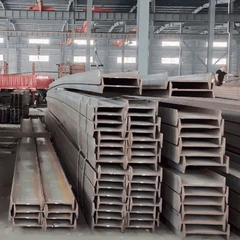


When dealing with H - section beams with composite materials, the equivalent moment of inertia is calculated by considering the contribution of each material to the overall stiffness of the beam. This involves using the rule of mixtures, where the properties of the composite are weighted based on the volume fraction of each material. The cross - sectional geometry of the H - section and the material properties of the individual components are used to determine the equivalent moment of inertia.
1.What are the design requirements for H - beam steel in manufacturing facilities?
In manufacturing facilities, H - beam steel design requirements include the ability to support heavy - duty machinery and production equipment. The steel should be designed to withstand dynamic loads from machinery operation, such as vibrations and impact forces. Corrosion resistance is important, especially in facilities with chemical or humid environments. The structure should also provide large - span spaces to accommodate production lines and material handling systems.
2.How to ensure the seismic performance of H - beam steel structures in high - seismic - risk areas?
In high - seismic - risk areas, to ensure the seismic performance of H - beam steel structures, the following measures can be taken. Use high - ductility steel materials. Design the structure with proper bracing systems, such as diagonal bracing or moment - resisting frames, to enhance lateral stiffness. The connections between H - beam steel components should be designed to allow for plastic deformation without brittle failure during an earthquake. Conduct seismic analysis and design according to relevant building codes.
3.What are the advantages of using H - beam steel in telecommunications towers?
In telecommunications towers, H - beam steel offers advantages such as high strength to withstand the wind loads and self - weight of antennas and other equipment. Its modular nature allows for easy installation and expansion of the tower structure. H - beam steel also has good fatigue resistance, which is important for towers that are constantly subjected to dynamic wind and vibration loads.
4.How to calculate the stability factor of H - beam steel columns under eccentric loading?
The stability factor of H - beam steel columns under eccentric loading is calculated using structural stability theories. The column's cross - sectional properties, length, end - support conditions, and the magnitude and direction of the eccentric load are considered. Formulas based on the Euler - Lagrange stability criterion or other relevant stability theories are used to determine the stability factor, which indicates the column's resistance to buckling under eccentric loading.
